
About HVS
What is Hydrogen Valley Südbaden?
What does the Hydrogen Valley Südbaden project do?
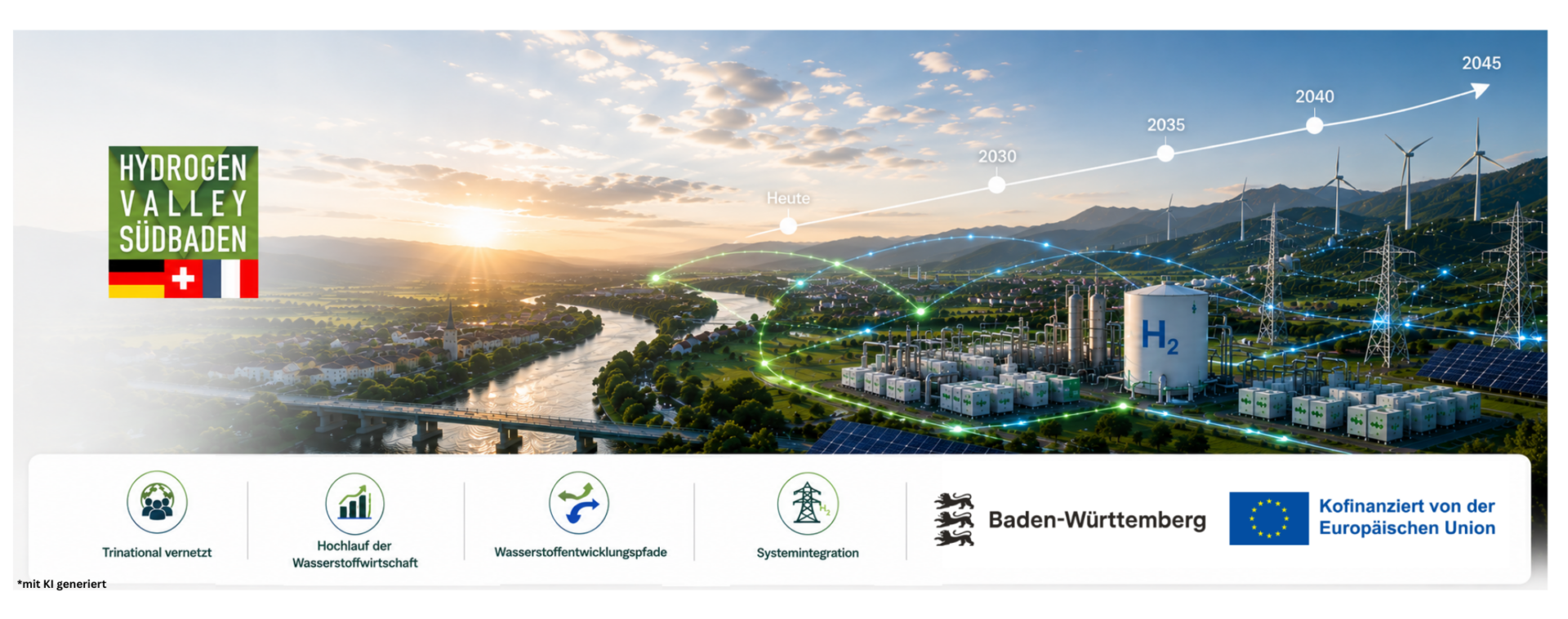
HVS focuses on hydrogen development pathways and infrastructure integration across the Southern Upper Rhine–High Rhine region, Alsace, and Northwestern Switzerland. The project combines energy system modeling, grid integration, and business model development.
Its main objectives are to:
- develop energy system models to analyze hydrogen development pathways through 2045,
- assess the interaction between hydrogen and electricity systems, as well as grid integration, using power flow simulations,
- develop business models and integrated energy concepts at the municipal level, and
- support the deployment and procurement of hydrogen infrastructure components for small and medium-sized enterprises (SMEs).
What is the motivation?
Partners

Klimapartner Südbaden e.V. leads Work Package 1 (German Cluster Development) and serves as the RegioWIN2030 lead partner for the overall project. The association brings together more than 50 companies and organizations within the trinational hydrogen initiative 3H2.
Within HVS, Work Package 1 strengthens and professionalizes the regional hydrogen cluster while promoting knowledge exchange among stakeholders. Klimapartner Südbaden coordinates stakeholder engagement and improves transparency regarding regional hydrogen projects and strategies.

Offenburg University of Applied Sciences (HSO) leads Work Package 2 (Research and Development), focusing on energy system modeling and grid integration. Two research groups from the Institute for Sustainable Energy Systems (INES) participate in the project: Energy Systems and Energy Economics (EEW) and Intelligent Energy Networks (IEN). The EEW research group develops the MyPyPSA-Ger energy system model to analyze hydrogen development pathways through 2045, while the IEN research group evaluates hydrogen–electricity system interactions using distribution grid simulations. Together, both groups also develop business models and integrated municipal energy concepts.